
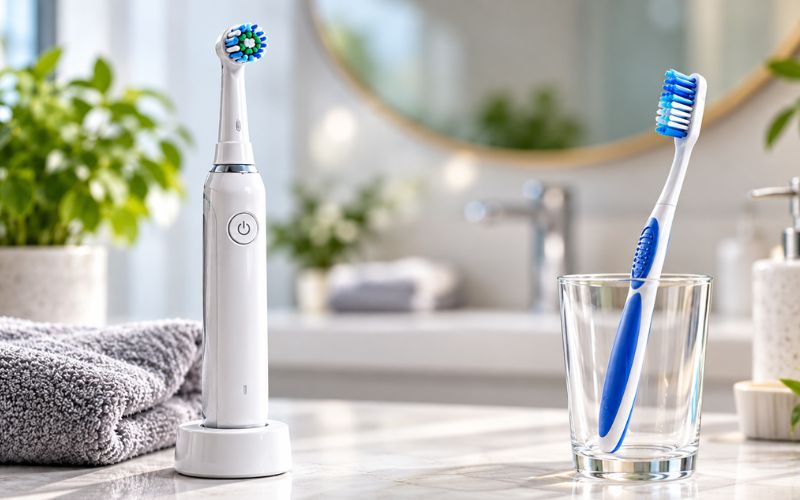
Choosing between an electric vs manual toothbrush can seem more complicated than it needs to be. Both can clean teeth effectively when they are used properly, but electric toothbrushes may make it easier for some people to brush consistently and control their technique.
Research has found that powered toothbrushes can reduce plaque and gingivitis more than manual toothbrushes on average. However, the difference does not mean everyone needs to replace a manual toothbrush. How thoroughly you brush, how often you brush and whether you clean along the gumline are still important.
If you are unsure whether your toothbrush or brushing technique is working well for you, a dental examination and professional clean can help identify areas where plaque is being missed.
Call Dr Raymond Platon & Associates in Wetherill Park on (02) 9609 2935 if you would like personalised advice about brushing, gum health or preventive dental care.
Electric vs manual toothbrush: which one is better?
Both electric and manual toothbrushes can clean teeth effectively when used correctly. Research suggests powered toothbrushes provide a modest average advantage for reducing plaque and gingivitis, but brushing technique, brushing time, pressure and cleaning between the teeth remain important. An electric toothbrush may be particularly useful for people who struggle with brushing consistently or thoroughly.
An electric toothbrush moves or vibrates the bristles for you, while a manual toothbrush depends entirely on the movement of your hand. Some electric toothbrushes also include timers and pressure sensors that can help with brushing for long enough and avoiding excessive pressure.
A large Cochrane review comparing powered and manual toothbrushes found that powered toothbrushes produced modest reductions in plaque and gingivitis compared with manual brushing. The researchers also noted that the long-term clinical importance of the difference was less certain.
In practical terms, this means an electric toothbrush may provide an advantage for some people, but good brushing technique remains more important than simply owning a particular type of toothbrush.
How does a manual toothbrush work?
A manual toothbrush removes plaque by physically moving the bristles across the tooth surfaces and along the gumline.
The Australian Dental Association recommends positioning a manual toothbrush at approximately a 45-degree angle so the bristles reach both the teeth and the gum margin. The brush should be moved systematically around the mouth so the outside, inside and chewing surfaces are cleaned.
You can read the Australian Dental Association’s guide to brushing with a manual toothbrush.
A manual toothbrush can work very well when you:
- brush thoroughly twice each day
- clean every surface of every tooth
- brush gently along the gumline
- use a soft-bristled toothbrush
- use fluoride toothpaste
- avoid rushing through the areas that are harder to reach
The main disadvantage is that the toothbrush cannot compensate for poor technique. If you brush too quickly, miss certain areas or scrub too hard, changing the toothbrush alone may not solve the problem.
What does an electric toothbrush do differently?
An electric toothbrush creates much of the brushing movement automatically.
Two common types are:
- oscillating-rotating toothbrushes, which usually have a small round head that rotates or oscillates
- sonic toothbrushes, which use rapid side-to-side movements
The Australian Dental Association explains that an electric toothbrush should generally be moved slowly from tooth to tooth, allowing the brush head to clean the surfaces rather than aggressively scrubbing.
You can see its step-by-step advice on how to brush with an electric toothbrush.
Some models also include features such as:
- two-minute timers
- 30-second quadrant reminders
- pressure sensors
- different brushing modes
These features are not essential, but they can be useful if you tend to brush too quickly or apply too much pressure.
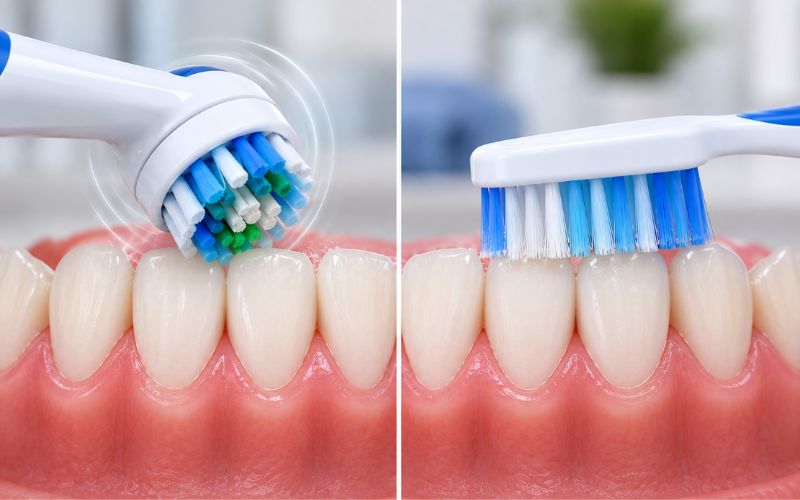
Electric and manual toothbrushes use different brushing movements, but both need to be guided carefully across the teeth and along the gumline.
Electric vs manual toothbrush: which removes more plaque?
On average, research suggests that powered toothbrushes can remove more plaque than manual toothbrushes. A Cochrane systematic review of 56 studies involving 5,068 participants found modest reductions in plaque and gingivitis with powered toothbrushes. The review reported an approximately 11% reduction in plaque after one to three months and 21% after more than three months, while gingivitis was reduced by approximately 6% and 11% respectively. The evidence was rated as moderate quality, and the authors noted that the long-term clinical importance of these differences remains unclear.
You can read the review on powered and manual toothbrushes from Cochrane.
This does not mean a manual toothbrush cannot clean your teeth properly.
Someone using a manual toothbrush carefully for the appropriate amount of time may clean their teeth more effectively than someone using an electric toothbrush poorly.
The better toothbrush is therefore the one that helps you consistently remove plaque without damaging your teeth or gums.
Who may benefit from an electric toothbrush?
An electric toothbrush can be particularly useful when manual brushing is difficult or inconsistent.
People who tend to brush too quickly
Many electric toothbrushes have built-in timers. These can make it easier to brush for approximately two minutes rather than stopping after 30 or 40 seconds without realising it.
People who brush too hard
Brushing harder does not necessarily clean teeth better.
Excessive pressure can irritate the gums and contribute to toothbrush abrasion over time. Some electric toothbrushes include pressure sensors that warn you when too much force is being used.
People with limited hand movement
Some people with arthritis, reduced dexterity or other limitations may find an electric toothbrush easier because the motor performs much of the brushing movement.
People undergoing orthodontic treatment
Brushing around brackets, wires and other orthodontic components requires additional care.
An electric toothbrush can be useful for some orthodontic patients, although the brush still needs to be guided carefully around each tooth and bracket.
Patients undergoing braces treatment at our practice can also receive brushing and oral hygiene advice during their orthodontic appointments.
Learn more about our orthodontic treatment in Wetherill Park.
People who repeatedly miss certain areas
Some patients clean the front teeth well but consistently miss the back molars, inside surfaces or gumline.
An electric toothbrush does not automatically solve this, but a small brush head and timed brushing routine can make systematic cleaning easier.
Electric vs manual toothbrush: is a manual brush still a good choice?
Yes.
A manual toothbrush remains a perfectly reasonable option for many people.
It is inexpensive, easy to replace, easy to travel with and does not require charging. More importantly, a manual toothbrush can remove plaque effectively when the correct technique is used.
You do not need an expensive toothbrush simply because it has more settings or technology.
If your teeth and gums are healthy, you brush carefully twice a day and your dentist or oral health therapist is not seeing significant plaque remaining in difficult areas, there may be no compelling reason to change.
Electric vs manual toothbrush: does technique matter more?
In many cases, yes. When comparing an electric vs manual toothbrush, the way you use the brush can be just as important as the type you choose.
The most sophisticated electric toothbrush will still leave plaque behind if it is moved too quickly or does not reach the gumline.
Similarly, a good manual toothbrush will not work well if you:
- brush for only a short time
- repeatedly miss the same teeth
- use excessive pressure
- ignore the inside surfaces
- avoid brushing near gums that bleed
- use worn or damaged bristles
One useful approach is to divide your mouth into four sections and spend roughly equal time cleaning each section.
The Australian Dental Association also recommends spitting out excess toothpaste after brushing rather than immediately rinsing thoroughly with water, allowing fluoride from the toothpaste to remain on the teeth for longer.
What type of toothbrush bristles should you use?
For most people, a soft-bristled toothbrush is appropriate.
Hard or very firm bristles are not required to remove ordinary dental plaque and may increase the risk of damaging the gums or tooth surfaces when combined with excessive brushing pressure.
The important factors are gentle pressure, thorough coverage and a brush head that allows you to reach the back teeth comfortably.
If your current toothbrush feels uncomfortable or your gums are becoming irritated, your brushing technique should also be assessed rather than simply changing to another firm brush.
Can brushing too hard damage your teeth or gums?
Yes, repeated aggressive brushing can cause problems.
Scrubbing forcefully can irritate the gum tissues and may contribute to wear around the necks of the teeth over time.
Signs that you may be using too much pressure include:
- toothbrush bristles spreading or flattening quickly
- tenderness after brushing
- visible gum recession
- sensitivity around exposed tooth surfaces
An electric toothbrush with a pressure sensor can help some patients recognise when they are pushing too hard, but gentle technique is still necessary with both toothbrush types.
If you have noticed receding gums or tooth sensitivity, a dental assessment can help determine whether brushing technique, gum disease, tooth wear or another factor may be contributing.
Learn more about our periodontal and gum care in Wetherill Park.
How long should you brush your teeth?
A useful target is approximately two minutes, twice a day.
Many people substantially underestimate how long they brush.
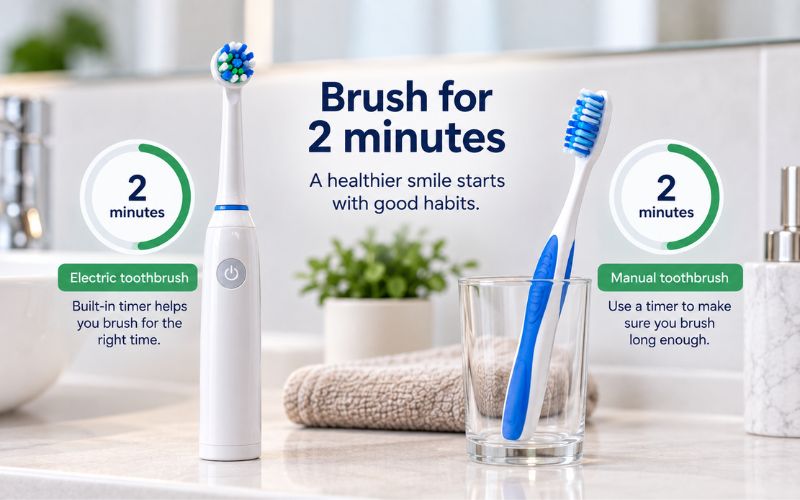
Whether you use an electric or manual toothbrush, brushing thoroughly for around two minutes twice a day helps clean all tooth surfaces.
An electric toothbrush with a timer can therefore be helpful, although a timer on your phone or another method works just as well with a manual toothbrush.
More time does not necessarily mean better cleaning if the technique is poor. The goal is to methodically clean all accessible tooth surfaces and the gumline without using excessive pressure.
Do you still need to clean between your teeth?
Yes.
Neither an electric nor a manual toothbrush reliably cleans all the spaces between adjacent teeth.
Interdental cleaning remains an important part of oral hygiene. Depending on your teeth and gums, this may involve:
- dental floss
- interdental brushes
- another interdental cleaning method recommended by your dentist or oral health therapist
If plaque remains between the teeth despite good brushing, gum inflammation and tooth decay can still develop in those areas.
Our oral hygiene instruction can be tailored to the areas you are finding difficult to clean.
What about children?
Either type of toothbrush can be used for children when it is age appropriate and used correctly.
For younger children, parental assistance and supervision are particularly important because children may not yet have the dexterity to clean every surface effectively.
An electric toothbrush can make brushing more engaging for some children, while others prefer the simplicity of a manual brush.
The brush should have an appropriately sized head and soft bristles.
The choice should ultimately be based on what allows the child’s teeth to be cleaned thoroughly and comfortably rather than whether the toothbrush is electric.
Electric vs manual toothbrush: do you need an expensive electric brush?
Not necessarily.
Higher-priced brushes may include additional settings, smartphone applications and other features, but those features do not automatically produce healthier teeth.
If you choose an electric toothbrush, the most useful features are often fairly simple:
- a comfortable brush head
- a two-minute timer
- a pressure sensor
- readily available replacement heads
How consistently and correctly you use the toothbrush matters considerably more than the number of modes it offers.
How often should you replace your toothbrush or brush head?
Replace a manual toothbrush or electric brush head when the bristles become worn, bent or frayed.
Many people replace them approximately every three months, although they may need replacement sooner if the bristles deteriorate.
If the bristles are becoming flattened very quickly, this can also be a sign that you are brushing with too much force.
What if your gums bleed when you brush?
Bleeding gums should not automatically be blamed on the toothbrush.
Gums often bleed when they are inflamed because plaque has accumulated around the gumline.
Avoiding the area completely can allow more plaque to remain and may make inflammation worse.
However, persistent bleeding should be assessed because gum inflammation can have several causes and may require professional cleaning or periodontal treatment.
If your gums regularly bleed when brushing or flossing, arrange a dental examination rather than simply switching between an electric and manual toothbrush.
Electric vs manual toothbrush: how can you tell if your brushing is effective?
Your toothbrush cannot tell you everything about your oral health.
Plaque can collect in places that are difficult to see, particularly:
- behind the lower front teeth
- around back molars
- close to the gumline
- between teeth
- around crowns, bridges or orthodontic appliances
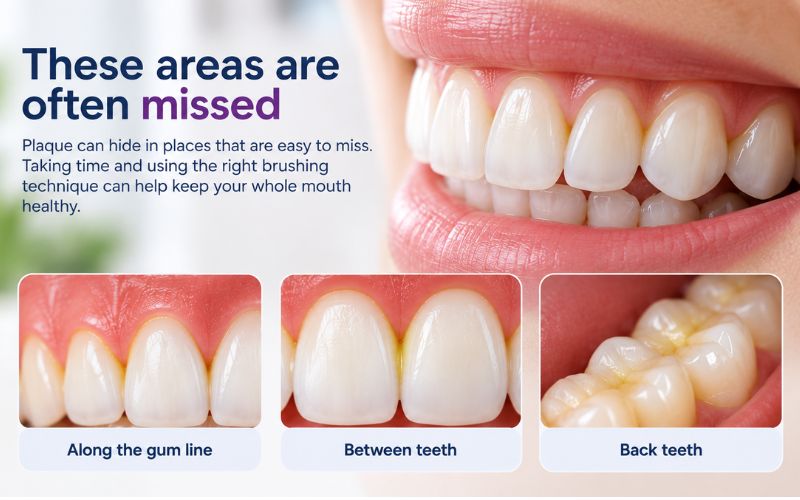
Plaque can remain in areas that are easy to miss, including along the gum line, between teeth and around the back teeth.
During a dental examination, your dentist or oral health therapist can identify areas where plaque, calculus or gum inflammation is present.
Professional dental cleaning can remove hardened deposits that cannot be removed with a toothbrush at home.
Electric vs manual toothbrush: what do we usually recommend?
There is no single toothbrush that is right for every patient.
A manual toothbrush may be completely suitable if you have good brushing technique and consistently clean all areas.
An electric toothbrush may be worth considering if you:
- struggle to brush for long enough
- use too much pressure
- have difficulty moving a manual toothbrush
- repeatedly miss certain areas
- wear braces or other appliances
- simply find an electric toothbrush easier to use consistently
The goal is not to choose the most expensive toothbrush. It is to find a brushing method you can use effectively twice every day.
Toothbrushing advice in Wetherill Park
At Dr Raymond Platon & Associates, brushing and oral hygiene advice can be tailored to what we actually see during an examination or professional clean.
For example, if plaque is repeatedly collecting around certain teeth, we can show you where it is being missed and discuss whether changing your technique, toothbrush or interdental cleaning method may help.
Our team provides preventive and general dental care for patients from Wetherill Park and surrounding areas including Bossley Park, Prairiewood and Fairfield West, as well as Greenfield Park, St Johns Park and Wakeley.
Oral hygiene and periodontal care may be provided by our dentists and Caroline Nguyen, Oral Health Therapist, AHPRA registration DEN0001948671, according to the patient’s individual clinical needs and each practitioner’s registered scope.
When should you ask your dentist about your toothbrush?
It is worth asking at your next appointment if:
- your gums regularly bleed
- your teeth remain visibly coated after brushing
- you have persistent bad breath
- your gums appear to be receding
- you have sensitive areas near the gumline
- your toothbrush bristles wear out unusually quickly
- braces, bridges or other dental work make cleaning difficult
Rather than simply recommending a particular brand, your dental practitioner can look at where plaque is collecting and suggest a technique or toothbrush that suits your mouth.
Frequently asked questions about electric vs manual toothbrushes
Is an electric toothbrush better than a manual toothbrush?
Research suggests that powered toothbrushes can provide modest reductions in plaque and gingivitis compared with manual toothbrushes. However, both types can be effective when used thoroughly and correctly.
Do dentists recommend electric toothbrushes?
Electric toothbrushes are often useful for patients who struggle with brushing technique, pressure or brushing time. They are not essential for everyone, and a manual toothbrush can still clean teeth effectively.
Can an electric toothbrush damage gums?
An electric toothbrush can irritate gums if it is used with excessive pressure. A pressure sensor can help, but gentle technique remains important.
What is the best toothbrush for receding gums?
There is no single toothbrush that treats gum recession. A soft-bristled toothbrush and gentle technique are generally appropriate, but the cause of recession should be assessed by a dental practitioner.
Should I change from a manual toothbrush to an electric one?
You do not necessarily need to change if your manual brushing is effective. If you repeatedly miss plaque, brush too hard or struggle to brush for long enough, an electric toothbrush may make your routine easier.
Need help improving your brushing technique?
When comparing an electric vs manual toothbrush, the most important question is whether your daily routine is keeping your teeth and gums clean without causing unnecessary trauma.
If you are concerned about plaque buildup, bleeding gums, sensitivity or areas you repeatedly miss when brushing, a dental examination can help identify what is happening and whether changes to your home care or professional treatment may be appropriate.
Call Dr Raymond Platon & Associates on (02) 9609 2935 to arrange an appointment.
We are located at 70 Lily Street, Wetherill Park NSW 2164.
Author:
Dr Raymond Platon
Principal Dentist
AHPRA DEN0001321891
Dr Raymond Platon & Associates
Wetherill Park NSW
Published: 17 November 2026
Reviewed: 17 November 2026